Two rules for converting a baking recipe to its gluten-free counterpart.

These bars look so good and will be perfect made with leftover cranberries.  When looking for recipes to make with gluten free ingredients, there are two rules of thumb:

1.  Most of the ingredients are naturally gluten free

2.  The recipe doesn’t rely on the gluten-ous texture of the flours to create the texture of the whole thing.

This beautiful bar fits the bill:

1.  The filling is gluten free.  If you use gluten free oats, the crumb crust & topping is mostly gluten free too.

2.  Substitute the 1 cup flour with the standard gluten free mix that you use, plus 1 tsp guar gum.  Since the texture of the bar doesn’t rely on the flour, you’re golden!

You can find this recipe at LifeMadeDelicious.

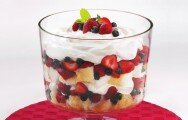
5 tips for making gluten free cake trifle

Image from Life Made Delicious

Gluten free cakes can taste better than their gluten counterparts, but there is some special care required if you’d like to use them for a typical layered trifle, like this easy recipe.  Because of the nature of gluten free baked goods, try these tips and your guests will never know that they’re eating a non-glutenous version of the favorite treat:

  1. Use the lightest gluten free cake recipe you have.  This will be so much easier when we finally get Betty Crocker gluten free mixes in Canada!  In the meantime, try this chocolate cake recipe.  Or this vanilla one.
  2. Do NOT soak the cake in alcohol or otherwise.
  3. Add the pudding or whipped cream just before serving.
  4. Dry the fruits well in advance of assembling the trifle.
  5. Assemble just before serving.

What I’m trying to say is, the cake will disintegrate if soaked.  So keep your ingredients dry.  Keep your cream whipped up separately, or better yet use well-set pudding or whipped topping instead.  Assemble all ingredients just before serving.  Add a drizzle of chocolate syrup or raspberry coulis and enjoy!

When adding milk to soup

Okay, this happens to me about 70% of the time, because I’m a very efficient cook. (read: impatient) The only way (that I know of) to keep milk from curdling your soup is to heat it up first.

Like the old fashioned pudding recipes: pour a bit into the milk, swoosh it around, then pour it slowly back into the pot. That was back in the day when you had to cook pudding – can you believe that?  Cook.  Pudding

Here’s my tip for efficient, and yet curdle-free soup – cook milk in microwave, while soup broth is heating on the element.   Don’t boil milk either.  I dunno why.  You’re just not supposed to – I think it has something to do with the milk separating and not being much milk-like any longer.

Another tip:  since you want the soup or stew thickened, but cannot boil the cornstarch if it is put in milk, be sure to thicken soup before you add milk.  Milk can be the next-to last ingredients.  Then stir until well combined and serve.

Good, right?

Although I haven’t been blogging much, I have, of course, still been cooking gluten free.  And I have a fantastic banana pie, and another brownie recipe for you coming up.  Stay tuned!

Reblog this post [with Zemanta]

Dear Strawberries: Timmy’s Vs. Starbucks

Q:  Which one is better:  Tim Horton’s or Starbucks?

A: Starbucks naturally.  ;) If you are asking about contamination and a cafe, the answer is nearly the same.  Tim Horton’s website declares none of their beverages or products to be gluten free.  Starbucks does not BAKE their own stuff there.  They essentially make beverages and stock the baking.

Tim Hortons is a bakery.  They bake with flour.  And it doesn’t take much to realize that flour get in the air, ducts, fans, etc and can end up anywhere or everywhere.  Nothing is guaranteed gluten free.  However, depending on your comfort level with the risk of contamination, I’m sure a fresh pot of coffee, in a disposable cup wouldn’t likely be contaminated.  Now, if you put sugar in your coffee, all bets are off.  They use a common sugar container when fixing beverages.

So, like I said, Starbucks kicks butt!  :)

Oh, and Happy Halloween!

Dear Strawberries: If distillation takes care of gluten, why do I react to whiskey?

This is an excellent question. Often, I think, your own belly is the best guideline. Because I’m sure that even if they say it is gluten-free, there are a minuscule amount of proteins that are ‘acceptable’ or deemed medically safe.  Or you are reacting to a non-glutenous source that your body doesn’t like.

What I found when I went looking for the source of my knowledge of distillation is this article by F rederik Willem Janssen,*  It was a very scientific article and difficult to slog through.  What I could learn from it was that there are not tests able to detect the small amount of protein that may splash into the distilled liquor AFTER it has been distilled, therefore contaminating it. That was in 1996. All articles since that time that I have come across do indeed say distilled alcohol and vinegar are safe no matter what they are derived from.

Hope that helps, and thanks for the great question!

Oh – by the way, celiac.com also has a list of gluten-free alcoholic beverages.

*Frederik Willem Janssen is the head of the Chemistry Department, Food Inspection Service in Zutphen, and a subsidiary of the Inspector of Health Protection (similar to the FDA in America).  He is also a member of the Medical/Scientific Advisory Committee of the Dutch Celiac Society.

Dear Strawberries: guar gum

Is my child the only one that plays in the sandbox with pretend cakes and guar gum?  Yep, the bubble blower wand became the teaspoon measurer and the sand was guar gum for a spell.  I had to wonder how many other four year olds know what guar gum is?  :)

Anyway:  Q: Why is xantham gum so much more expensive than guar gum and can I use the cheaper one?

A: I don’t know.  And some times.

They are both gums, producing a binding effect in gluten free baking.  Unfortunately we are not able to use other grains to the same effect as wheat, wheat seems to contain a particularly binding quality and also a unique flavor (that is difficult to replicate).  So we use several binding agents in combination:

  • eggs
  • guar gum
  • xantham gum
  • sweet rice flour
  • unflavored gelatin

Since I’m not sure how they all work, I follow the recipe with the exception of xantham gum – I couldn’t stomach the cost of it without knowing why it was preferred over guar gum.  What I have found, and it works for me too, is that guar gum reacts with the function of yeast in breads.  For all my baking, I use guar gum except when using yeast, then I use xantham gum to prevent any weirdness.  So I have my trusty guar gum (much, much more economical) and use xantham gum in my bread.

As a note: I also use quite a bit – 1 Tablespoon – in each loaf of bread in place of 2 of the eggs.  I find that most loaves require 4 or more eggs and that they tend to have that heavy egg texture – like in cruellers or other egg doughs.  So using less eggs and more xantham gum works for me.  You’ll have to figure out what your family can stomach when it comes to the texture of things, and then adjust your budget accordingly.

Please send your questions to cathy (at) tibbles (dot) net!